A Dermatologist, a Free Gemini Plan, and a Weekend: The 2-3 Hour App That Hit HN’s Front Page
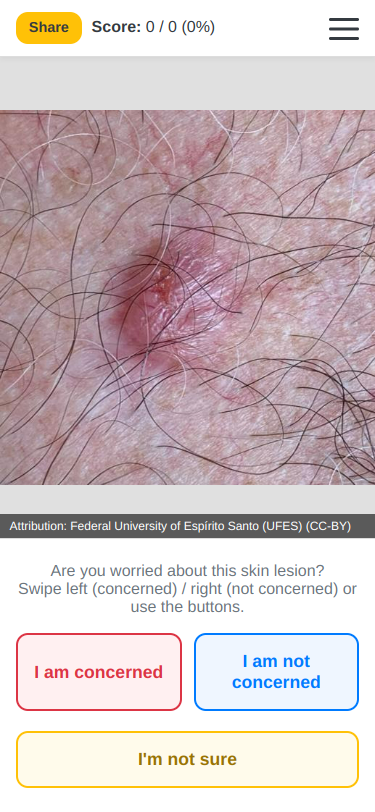
A UK skin-cancer specialist vibe-coded a “swipe left or right” training game for spotting skin cancer — in a single afternoon, for £5 a month. The story isn’t the code. It’s who wrote it.
Most “Show HN” hits are built by engineers. This one was built by the person who actually knows the problem.
A practicing dermatologist — posting as sungam — shipped MoleCheck, a browser game that shows you a real photo of a skin lesion and asks a single, honest question: Are you worried about this, or not? You swipe left for “concerned,” right for “not concerned,” or tap “I’m not sure.” It keeps score. That’s the whole app. It hit 429 points and 259 comments on Hacker News.
And here’s the part that should make every domain expert sit up: by his own account, he built it “using Gemini Pro 2.5 (free version) in about 2-3 hours.”
What was actually built
The maker was refreshingly specific about the stack — no mystique, no “AI magic”:
“Coded using Gemini Pro 2.5 (free version) in about 2-3 hours. Single file including all html/js/css, Vanilla JS, no backend, scores persisted with localStorage. Deployed using ubuntu/apache2/python/flask on a £5 Digital Ocean server… Images / metadata stored in an AWS S3 bucket.” (HN)
A single HTML file. No framework. No database. A five-pound-a-month server he admits “could have been hosted on a static hosting provider as it’s just a single page with no backend.” This is the entire technical footprint of something that reached the front page of Hacker News and, more importantly, does something genuinely useful.
The genius isn’t in the engineering. It’s in the framing of the problem — and that came from years in clinic, not from Gemini.
Why a doctor, not an engineer, is the real story
Ask an engineer to build a skin-cancer app and you’ll likely get an ambitious AI classifier that tries to diagnose your mole from a photo. Ask a dermatologist, and you get something far smarter about human behavior. The maker explained his reasoning:
“The main motivation… was that lots of my patients wanted me to guide them to a resource that can help them improve their ability to recognise skin cancer and, in my view, a good way to learn is to be forced to make a decision and then receive feedback on that decision.” (HN)
He reframed the entire task. The app isn’t trying to be the doctor — it’s training the patient’s eye. As he put it, the patient’s real decision “actually is binary — either (i) I contact a doctor about this skin lesion now or (ii) I wait.” His clinical insight is that “the large majority of skin cancers are fairly obvious and the main reason people don’t spot them is because they are not checking their skin regularly and don’t have any idea what to look for.”
That’s the kind of product judgment no amount of prompt engineering can manufacture. He even named the clinical heuristic the game quietly teaches — the “Ugly Duckling” sign — the lesion that looks different from all your others.
The caveats — and to his credit, he raised most of them himself
This is medical-adjacent software, and the maker did not hide from it. Asked about AI diagnosis, he was blunt:
“I would not trust any [model] for diagnosis without review of a dermatologist yet. The challenge is unanticipated edge cases and managing risk/liability/regulation.” (HN)
He was equally candid about the app’s limits. Commenters pointed out the quiz showed too many cancers versus harmless lesions — skewing a learner’s sense of base rates. He agreed: “the distribution is not equal largely because the dataset that I used had less pictures of harmless moles but I will aim to make it 50:50 in the next version.” He conceded the app launched with “just the basics” because he “didn’t expect anyone apart from a few of my patients to use” it.
Those caveats matter. A training game that over-represents cancer could nudge anxious users toward false alarms; image datasets can carry their own biases in skin tone and body site. None of this is disqualifying for a learning tool — but it’s the line between “useful education” and “accidental medical advice,” and it’s worth watching whether v2 holds that line.

The bigger signal
Strip it back and the lesson is bracing. The barrier to building this was never the code — it was time, and AI removed it. In the maker’s words: “without AI this app definitely would not exist as I would not have had time to make it… I could probably have worked out how to do it myself but it would have taken weeks.”
For a decade, the standard advice to non-engineers with a great idea was: find a technical co-founder. What MoleCheck shows is a third path — the expert ships the v1 themselves, in an afternoon, and only recruits help once the idea is proven. He sees it generalizing: “I’m pleased that people have found it useful and definitely only possible because of AI coding. I agree that this is likely to be applicable to non-experts in many different areas.”
The most valuable thing in software has always been knowing exactly what to build. We just handed that superpower to the people who already know — the doctors, teachers, mechanics, and specialists who understand a problem in their bones but never had a spare three weeks to learn React. Some of what they ship will be naive. Some of it, like this, will be quietly brilliant.
Why it matters
- The bottleneck was time, not skill. A dermatologist shipped a useful skin-cancer training tool in 2–3 hours with free-tier Gemini — work he says would otherwise have taken weeks and never happened.
- Domain expertise is the moat. The app’s smartest move — training the eye instead of faking a diagnosis — came from clinical experience, not engineering.
- Expert + AI needs guardrails. Dataset balance, skin-tone bias, and the education-vs-advice line are real risks; notably, the maker flagged most of them himself.
MoleCheck is an educational tool, not a diagnostic device. It does not provide medical advice; consult a doctor about any skin concern. Source: Show HN (Hacker News, 429 points, 259 comments). Project: molecheck.info. Screenshot shows the app’s learning quiz; lesion image attributed on-screen to Federal University of Espírito Santo (UFES), CC-BY.